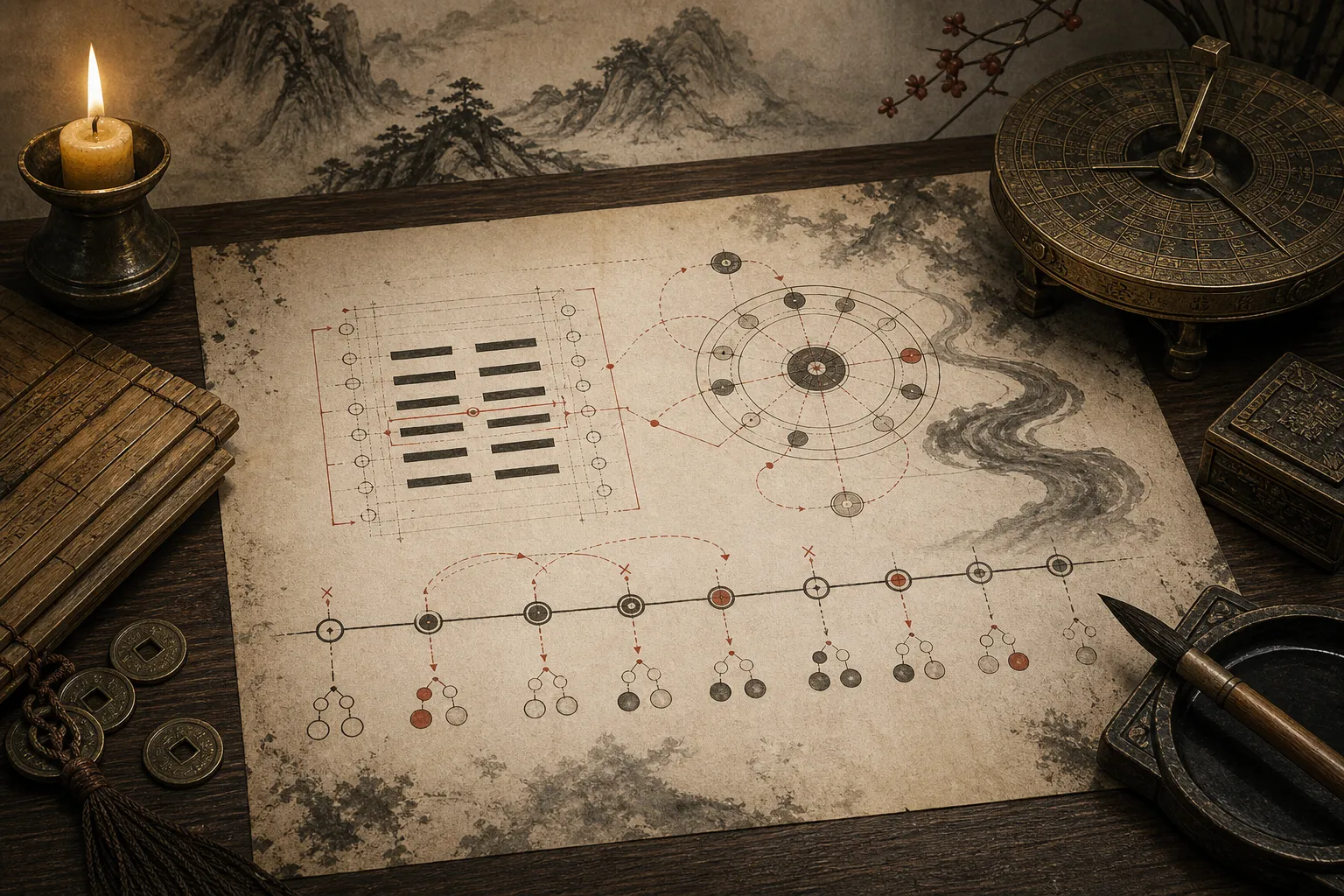
Act 8
Timing
Your task in Act 8 is to turn one positioned line subject into a timing record that another reader can reproduce. The record may contain a primary candidate, alternatives, or no supported window.
A candidate window is not a promise that an event will occur. It is a conditional result derived from declared chart and calendar inputs under either an attributed timing rule or an explicitly labelled UAYA course convention. Keep the chart calculation, the line’s interpreted effect, and the timing candidate as three separate layers.
Before you begin
Bring one completed record from the earlier acts:
Question horizon:
Selected line position (1–6):
Selected line branch:
Why this line is the subject:
Temporal assessment:
Movement and transformed branch, if any:
San He and hidden-line context, if any:
If the subject is not a line, has no position, or lacks the calendar facts needed by the stated rule, record insufficient and stop. Do not reconstruct missing inputs from a desired answer.
The Act 8 sequence
| Step | Learner job | Record produced |
|---|---|---|
| 1 | Derive the governing line condition | Primary condition plus retained observations |
| 2 | Orient with the four teaching questions | State map |
| 3 | Generate void candidates | Value and clash rows |
| 4 | Release a bound state | Binder-clash rows |
| 5 | Stabilize a clashed state | Subject/attacker combination rows |
| 6 | Handle selected static lines | Value and clash rows |
| 7 | Handle moving and Dark Moving lines | Moving-line value and combination rows; no window for Dark Moving without its own sourced rule |
| 8 | Record near and far limits | Horizon and precision note |
| 9 | Add San He context | Frame context and source boundary |
| 10 | Record transformation delays cautiously | Hua Kong/Hua Po context and stop record |
| 11 | Rank and report without hiding alternatives | Final timing record |
The order matters as a UAYA course convention: record blocking or unresolved conditions before movement, and keep every secondary observation visible. A frame or transformed branch does not become an independent subject.
When a lesson cites a received timing statement, use that statement only within its stated scope. When no public source supplies a timing operation, the lesson records context or stops rather than inventing a date.
The record you will produce
Subject: line __ / branch __
Governing line condition:
Secondary observations:
Rule source or UAYA convention:
Derivation:
Primary candidate:
Alternatives:
Question horizon and precision limit:
Output: candidate set / no window / insufficient
Post-window status: open / observed / missed / unresolved
No window, insufficient, missed, and unresolved are complete records. They should not be repaired by changing the question after the fact.
Source note
The principal received timing reference for this act is Zengshan Buyi, vol. 1, “General Notes on Response Times for the Various Categories” (各门类应期总注章), checked composite printed pp. 48–49 / PDF physical pp. 49–50. It discusses value and clash, movement with value or combination, release from combination, void filling or clash, and the distinction between near and far matters. It does not supply one universal timetable or establish an outcome. Any additional ordering or record format in these lessons is identified as a UAYA teaching convention.
Next step
Start with the operation every later comparison depends on: derive the positioned line’s governing condition.
The modules
Derive one governing condition for a positioned line before comparing conditional timing windows.
8.2 The Four States of StasisUse four teaching questions to orient line conditions without turning a label into an outcome.
8.3 Void TimingCompare the received filling, value, and clash markers for a void line without inventing a universal ranking.
8.4 Bound TimingIdentify the branch creating a bound state and compare sourced clash-release candidates without promising an outcome.
8.5 Clashed TimingRecord both sides of a clash and apply combination timing only when an attributed rule supports it.
8.6 Static-Line Value and ClashCompare the received value and clash timing markers for a selected static line without turning strength into certainty.
8.7 Moving-Line Value and CombinationCompare the received value and combination markers for a moving line without treating movement as certainty.
8.8 Near and Far TimingRecord question horizon, source-supported calendar scale, calendar anchor, and uncertainty without manufacturing precision.
8.9 Frame TimingAdd San He context to a positioned line while withholding dates that lack a sourced timing rule.
8.10 Transformation TimingRecord Hua Kong or Hua Po transformation context and withhold dates that lack a sourced timing rule.
8.11 When Indicators ConflictCompare sourced timing candidates, preserve alternatives, and report insufficient or no window without false certainty.