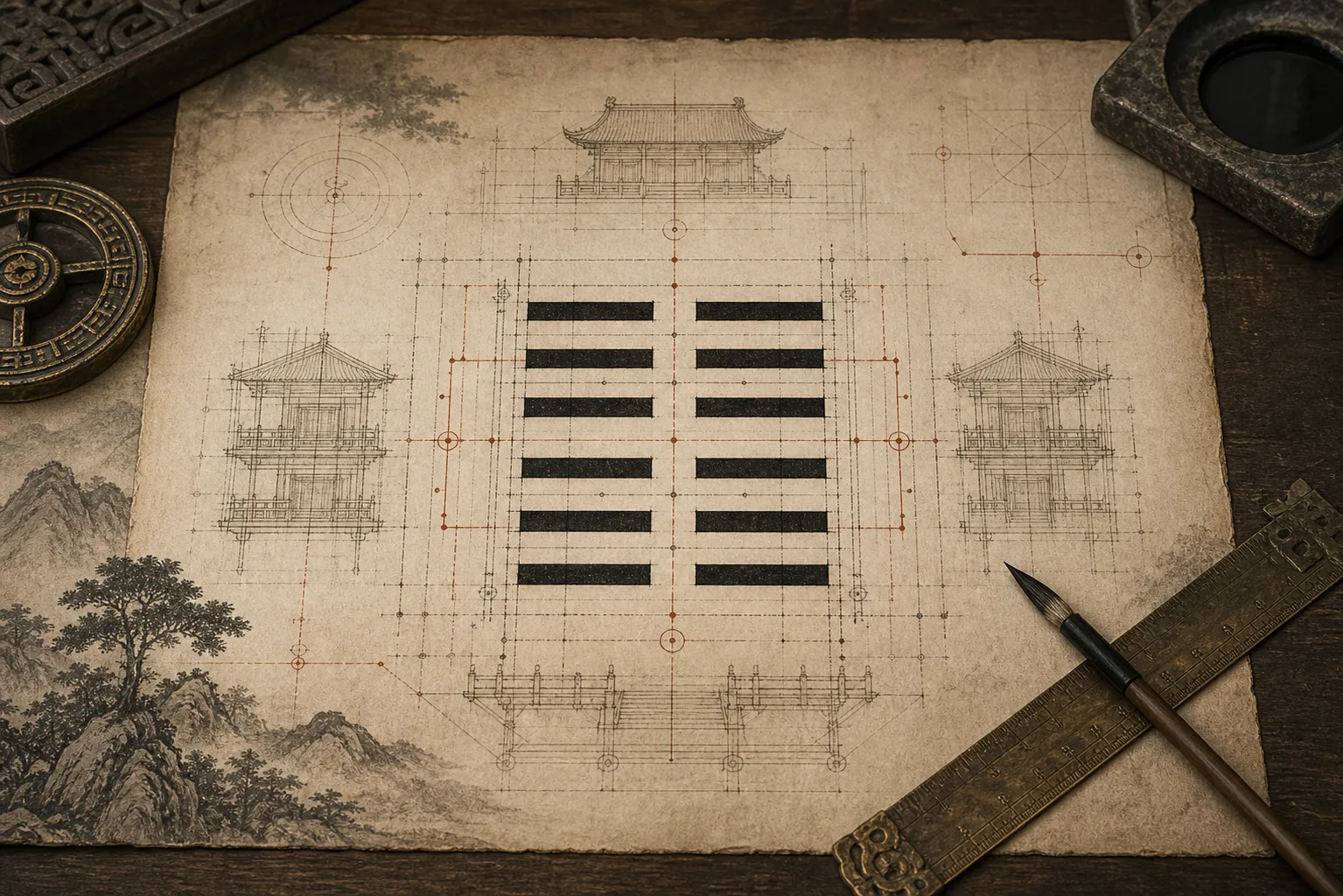
Traditional scholarly blueprint of a Wen Wang Gua hexagram structure

Act 2

The Hexagram Skeleton

Last updated 5/17/2026

Time to actually decode a cast. This act covers everything you can read off a hexagram before the date enters the picture — the palace, the stem-branch labels, the relative types, World and Response, moving lines, and the Six Spirit row. Pure structure. No timing, no strength, no judgment yet. By the end, you can look at a fresh cast and fill in every label without a calendar in hand.


What this act is

A cast diagram has two layers — a static layer that’s just a property of the hexagram (palace, stem-branch labels, relative types, World/Response positions), and a dynamic layer that depends on the date (Act III). This act covers the static layer end-to-end.

It’s the most arithmetic-heavy stretch of the course after Act III. There’s no way around it — every later act assumes you can put the stem-branch layer on a hexagram without thinking about it. The good news: once it’s in your hands, it stays. We come back to these pieces dozens of times in later acts but never re-teach them.


Where this sits

  • Carrying forward from Act I: you can visually parse a cast diagram (1.5). Now we explain what every label means.
  • Opens up: Act III (the calendar needs each line’s branch to operate on); Act IV (target-line selection needs the relative types); essentially everything.
  • Once we land here, we don’t re-explain: the palace assignment algorithm, the stem-branch order for the eight trigrams, how relative types derive from palace element, the World/Response position table, the Six Spirit day-stem mapping.

Working labels in this act

The course uses plain working labels first. Technical source labels belong in the Wen Wang Gua Terminology reference, where they can be checked without interrupting the lesson.

  • Eight Palaces — Jing Fang’s grouping of the 64 hexagrams into eight families. (2.1)
  • Palace positions — palace head, first through fifth generation, Soul-Wandering, Soul-Returning. (2.1)
  • Palace element — the element inherited from the palace anchor. (2.2)
  • Stem-branch labels — the fixed calendar identities installed on each line. (2.3)
  • Inner / outer trigram — lower and upper trigram positions; the assignment table changes depending on position. (2.3)
  • Relative types — Parent, Officer, Sibling, Wealth, Child. (2.4)
  • World / Response — the querent’s line and the question’s mirror line. (2.5)
  • Moving line, transformed line, changed hexagram — the motion structure of the cast. (2.6)
  • Six Spirits — Azure Dragon, Vermilion Bird, Hooking Array, Soaring Serpent, White Tiger, Black Tortoise. (2.7)

What we’re deliberately holding off on

  • Branch elements at the interaction level — we’ll say “Yin branch is Wood,” but not “Wood generates Fire” yet. That’s Act III.
  • Void — the cast header shows a void pair, but the mechanics wait for III.2.
  • Seasonal strength states — the five seasonal states wait for III.7.
  • What it means when a line moves and transforms — Act VI’s 8 dynamics. Here we only define what motion is.
  • The interpretive role of the Six Spirits — Yehe demotes them; we treat them as contextual flavor in this act and reserve the few diagnostic uses for Act IX.
  • Target-line selection — we can see that a line is the Parent line, but choosing which line answers the question is Act IV.

The modules

2.1 — The Eight Palaces

Jing Fang’s organizing scheme. The 64 hexagrams are grouped into eight palaces of eight, each anchored by one of the eight doubled-trigram hexagrams. Within each palace, the seven derived hexagrams are generated by a specific cascade of line changes. The palace assignment matters because it determines the palace element, which determines the relative types — so getting the palace right is upstream of half of everything.

We build the Qian palace step by step, watching Qian over Heaven transform line by line through Fire over Heaven.

Common trap: confusing the “King Wen sequence” (1–64) with palace sequence. They’re orthogonal.

Where it lands us: palace identified — what does it tell us? → 2.2.

2.2 — Palace Element

Each palace has an element inherited from its anchor trigram: Qian and Dui are Metal, Li is Fire, Zhen and Xun are Wood, Kan is Water, Gen and Kun are Earth. This element is the reference point against which every line in the hexagram gets typed as a relative. Two hexagrams that look nearly identical can belong to different palaces and produce completely different relative-type profiles.

We compare Wind over Heaven (Xun palace, Wood) with Mountain over Heaven (Gen palace, Earth) — same lower trigram, very different chart.

Common trap: trying to use the hexagram’s “own element” instead of the palace’s. The palace wins.

Where it lands us: element established — how do stems and branches get assigned to lines? → 2.3.

2.3 — Stem-Branch Assignment (Najia)

The mechanical heart of WWG. Every line carries a heavenly stem and an earthly branch — and that assignment is a property of the hexagram, not the date. Two casts of the same hexagram on different days have the same line branches. The Day decides what’s strong; the stem-branch layer decides what’s there.

We work through the assignment tables for each of the eight trigrams, attending to the difference between inner-trigram and outer-trigram tables and the yin/yang split. Then we fill in Case 1’s branches for Qian over Heaven becoming Wind over Heaven: Zi, Yin, Chen, Wu, Shen, Xu. These are the branches we’ll come back to over and over.

Common trap: using the same najia table for inner and outer trigrams. Different rules. Easy to get wrong the first ten times; gets automatic after.

Where it lands us: every line has a branch — and therefore an element. Now we label the lines themselves. → 2.4.

2.4 — The Relative Types

Five categories — Parent, Officer, Brother, Wealth, Child — derived from the Five-Phase relationship between each line’s element and the palace’s element. Generates-the-palace = Parent. Controls-the-palace = Officer. Same-element-as-palace = Brother. Generated-by-the-palace = Child. Controlled-by-the-palace = Wealth.

It’s a rule, not a memorization task. We derive it; we don’t look it up. We annotate Case 1 (Qian palace = Metal): the Fire lines are Officer, the Water line is Child, and so on.

Common trap: memorizing case-by-case (“in Qian over Heaven, line 4 is Officer, Wu Fire”). Derive every time. Also: confusing the type with the domain meaning — “Wealth” is a line type; “wife” or “money” or “business deal” are domain interpretations we’ll meet in Act IX.

Where it lands us: lines have types. But which line is you, the person asking? → 2.5.

2.5 — World and Response

The querent has a place on the board — the World line — and the question’s object has its mirror, the Response line, three positions away. Where these sit depends on the palace position (palace head, first through fifth generation, Soul-Wandering, Soul-Returning), and the eight patterns are worth memorizing because everything from target-line selection to interval lines builds on this.

We walk through Case 1: Qian palace, palace-head position → World on line 6, Response on line 3. Earlier drafts of this outline mistakenly said fifth generation; Qian over Heaven is the palace head, with World always on line 6.

Common trap: assuming World is always the moving line, or that Response is “across” from World in some other sense than the position rule prescribes.

Where it lands us: the static layer is almost complete. One thing left: motion. → 2.6.

2.6 — Moving, Changing, Transformed

A cast actually contains two hexagrams: the primary one you cast, and a changed hexagram derived from the moving lines. Moving lines are the calculation layer of WWG’s dynamism — they’re what changes a static labeled diagram into a story.

We define the moving line and the transformed line. We mark motion visually (Ă— for yin-moving-to-yang, â—‹ for yang-moving-to-yin) and construct the changed hexagram from the primary hexagram plus the moving positions. In Case 1: line 4, Officer, Wu Fire, moves and transforms to Parent, Wei Earth; the changed hexagram is Wind over Heaven.

We do not yet say what motion means for the outcome. That’s Act VI — motion is the beginning of a matter, transformation is where it resolves, and there are eight specific dynamics to learn. Here we just establish the vocabulary.

Common trap: treating the changed hexagram as the answer. It’s the effect — important but not the verdict. Ignoring it entirely is the other trap.

Where it lands us: the skeleton is essentially complete. One last row to label → 2.7.

2.7 — The Six Spirits

The left-margin row: Azure Dragon, Vermilion Bird, Hooking Array, Soaring Serpent, White Tiger, Black Tortoise. They rotate up the chart based on the day’s heavenly stem, and they survive in WWG as contextual flavor — not as primary decision inputs. Yehe Laoren’s famous demotion: “how can the multitude of spirits compare to the one principle?”

We learn the day-stem rotation (Jia/Yi days put Azure Dragon on line 1; Bing/Ding put Vermilion Bird there; Wu puts Hooking Array there; Ji puts Soaring Serpent there; Geng/Xin put White Tiger there; Ren/Gui put Black Tortoise there), apply it to Case 1, and note the few narrow diagnostic uses we’ll meet later — but we frame them as flavor, not as a Yi Yin–style primary system.

Common trap: treating the Six Spirits as primary determinants. Writing dramatic interpretations from White Tiger alone. Both are characteristic of the lineage we don’t follow.

Where it lands us: the skeleton is done. The cast is fully labeled and entirely static. Time to bring the calendar in → Act III.

Checkpoint

By the end of Act 2, you can build the static chart: palace, palace element, line branches, line roles, World and Response, moving lines, transformed lines, changed hexagram, and Six Spirits. You are not judging anything yet. You are making the chart readable.