Advanced I Ching Studies
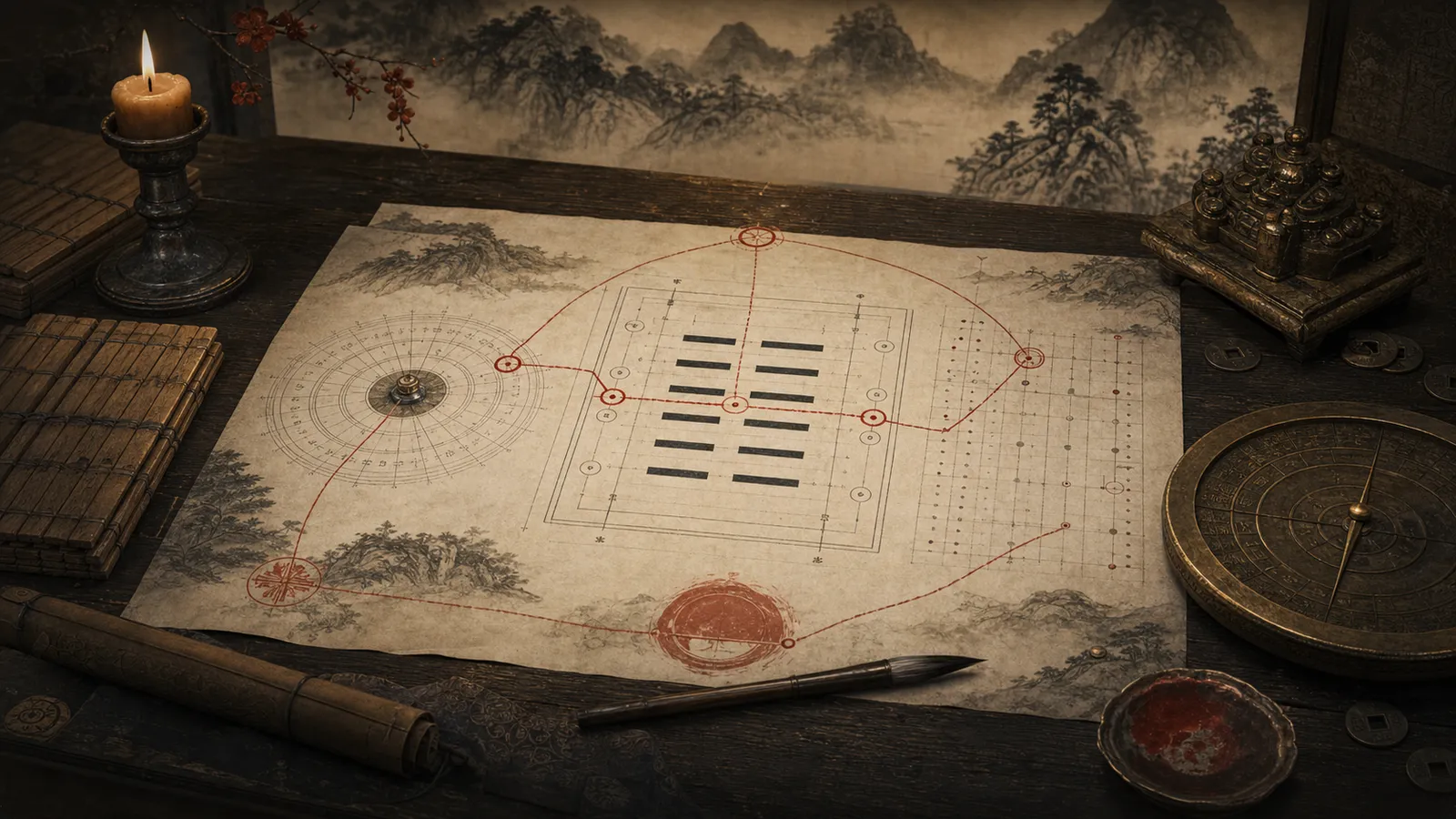
Wen Wang Gua An Advanced Course
Wen Wang Gua reads an I Ching cast through hexagram structure, line roles, stems and branches, Five Phases, target-line selection, strength, and timing. This course teaches those layers as one repeatable reading method.
The Reading Pipeline
Acts 1 and 2 make the cast readable: source position, visible table literacy, palaces, line roles, World and Response, movement, and transformed lines.
Animate Then add timeAct 3 puts the chart under the month and day so each line has condition, pressure, absence, release, or hidden activity.
Select Then choose the targetAct 4 gives the reading a center. The question decides which line carries the answer before strength or movement can be judged.
Decide Then judge and time itActs 5 through 8 turn target condition, support, obstruction, movement, and timing states into a verdict with a practical window.
Apply Then make it usefulActs 9 and 10 adapt the same method to real domains, responsible wording, refusal, case review, and long-term practice.
What You Learn
Palaces, line roles, World and Response, moving lines, transformed lines, and the six visible rows of the cast.
02 Add the calendarUse stems, branches, void, month force, day force, Five Phases, and branch relationships through plain working labels.
03 Pick the target lineIdentify which line represents the actual question, then track the supporting and opposing forces around it.
04 Make a judgmentConvert line strength, motion, combinations, clashes, and timing states into a clear reading with honest confidence.
Acts
What Wen Wang Gua is, where it comes from, what source tradition we follow, and how to read the visible parts of a cast table.
Act 2 The Hexagram SkeletonThe static structure: palaces, line roles, World and Response, movement, transformation, and Six Spirits.
Act 3 The CalendarGanzhi, void, Five Phases, month branch, day branch, and the seasonal-strength framework.
Act 4 The Target Line SystemThe question determines the target. This act teaches the selection rules and the supporting/opposing line roles.
Act 5 Strength and InteractionThe analytical heart: strength states, void, breakers, dark movement, combinations, clashes, harms, and punishments.
Act 6 Advanced Line BehaviorMoving-line dynamics, self-transformation, multiple moving lines, relevance filtering, and intermediary lines.
Act 7 JudgmentTurn the analysis into an outcome by comparing target strength, opposing force, movement, and confidence.
Act 8 TimingPredict when the cast resolves using state-based timing rules and a precedence hierarchy.
Act 9 Domain ApplicationsAdapt the same machinery to career, wealth, health, romance, legal disputes, travel, documents, weather, and broad life questions.
Act 10 Ethics and MasteryWhen to decline a reading, how to avoid fatalism, how to communicate high-stakes answers, and how to build a case library.
Reference Shelf
Source Position
We follow the Added-to and Subtracted-from Divination tradition, usually cited as Zengshan Buyi from Yehe Laoren, with support from The Orthodox Method of Divination and Golden Strategy. We do not teach spirit-symbol-heavy shortcuts or later popular doctrines that the core sources reject.
Worked examples and rule checks also draw from Bushi Quanshu, Huozhulin, Yiyin, Yimao, and Yilin Buyi when they clarify, corroborate, or contrast a rule.
The practical rule is straightforward: if a doctrine affects a reading, we explain the source logic. If a doctrine is contested, we name the dispute. If a doctrine is refuted, we say why.