Philosophy
Echoes of the Dao: Taoist Roots and Resonances in the I Ching
While the I Ching predates the formal emergence of Taoism (Daoism) as a distinct philosophical school, its core principles and worldview share profound resonances with Taoist thought. Many scholars see the I Ching as one of the foundational texts from which Taoist philosophy later drew inspiration, particularly concerning the nature of reality, the concept of the Dao (the Way), and the wisdom of aligning oneself with natural processes.
This article will delve into the Taoist roots and philosophical connections found within the I Ching, examining shared concepts such as the ceaseless flow of change, the interplay of Yin and Yang, the idea of Wu Wei (non-action or effortless action), and how both traditions offer paths to understanding and harmonizing with the cosmos.
The River and the Bed
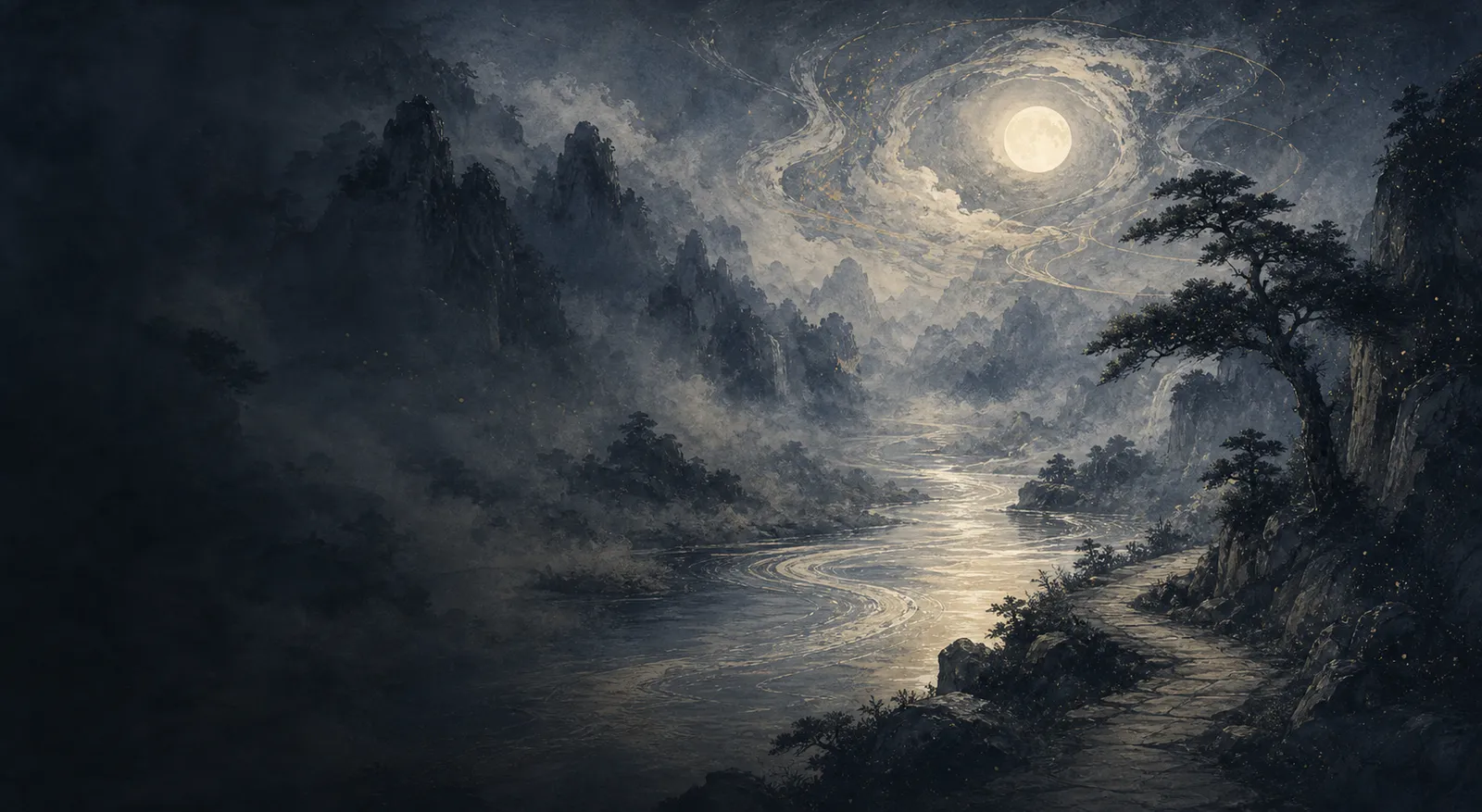
Imagine you are standing in the middle of a fast-moving river. You have two choices: you can plant your feet and try to hold back the current with your hands, or you can tuck your knees, let the water take your weight, and navigate the rocks by feeling the pressure of the flow against your skin.
Most of us approach the “Book of Changes” as if we are trying to stop the river — we want to know the future so we can control it, freeze it, or prevent the water from moving. But the Taoist roots of this system suggest something else entirely. They suggest that the I Ching isn’t a book of “secrets” to be hoarded; it is a map of the currents.
Reorienting the Flow
You may think the I Ching is a collection of 64 separate “fortunes.” In reality, it functions as a single, breathing description of the Dao — the path of least resistance and greatest integrity.
When a Taoist practitioner looks at a hexagram, they aren’t looking for a “yes” or “no” to a business deal. They are asking: “What is the nature of the water right now? Is it pooling, is it crashing, or is it evaporating?” The goal is not to change the river, but to change how you swim. This is what early commentators referred to as “knowing the seeds” — the subtle beginnings of change.
| Taoist Concept | I Ching Resonance | What This Really Means |
|---|---|---|
| The Dao (Way) | The Sequence of Hexagrams | The logical, inevitable progression from one state to the next |
| Wu Wei (Non-Action) | Receptive Yin lines (⚋) | The power of “effortless action” — knowing when the most effective move is to wait |
| Ziran (Naturalness) | Trigram Images (Wind, Water, Lake) | Aligning human behavior with the raw, unforced patterns of nature |
| Yin-Yang | The solid and broken lines | The binary heart of the system; the pulse of inhale and exhale |
The Art of Effortless Action (Wu Wei)
The most misunderstood concept in the I Ching’s Taoist heritage is Wu Wei. We often translate it as “doing nothing,” but in practice, it is “doing nothing that is inconsistent with the Dao.”
In the I Ching, this appears most clearly in the Receptive (Kun, Hexagram 2). If you find yourself in a situation where every line is broken and yielding, a Taoist interpretation tells you that the energy of the moment is fertile but passive. To force a decision here is like trying to make a plant grow by pulling on its leaves. You don’t gain time; you only kill the plant. The “action” required is the action of alignment — preparing the soil so that when the season changes, the growth happens by itself.
This process involves a kind of mystical programming, where we use the hexagrams as a periodic table to navigate and sometimes even override literal natural cycles by aligning our internal qi with the cosmos.
How This Shows Up in Real Life
You recognize this dynamic most clearly in the lifecycle of a project or a relationship:
- The Sprouting (Wood/Spring): There is a sudden burst of vision, like Hexagram 3 (Difficulty at the Beginning). It feels chaotic because the potential is greater than the structure.
- The Climax (Fire/Summer): Everything is visible. You are at the “top” of the hexagram. There is nowhere left to go but down or inward.
- The Return (Earth/Late Summer): The need to ground yourself and synthesize what has been learned.
Practical Application
When working with these Taoist resonances, ask yourself:
- Am I forcing the current? If the reading suggests obstruction, the Taoist move is to stop pushing and observe where the water is diverted.
- Is this a time for inhaling or exhaling? Yang lines represent the output of energy; Yin lines represent the recharge. If your life is currently all Yin, you aren’t “failing” — you are inhaling.
- What is the Ziran (Naturalness) of the situation? If the trigrams involved are Mountain and Lake, the “natural” behavior is stillness and reflection, not movement and noise.
Closing Synthesis
The Taoist roots of the I Ching remind us that we are not separate from the systems we consult. We are not “using” a tool to look at the world; we are using a mirror to see where we have fallen out of step with the world’s natural rhythm. By returning to these roots, we move away from the anxiety of “what will happen” and into the confidence of “how to be.”