Philosophy
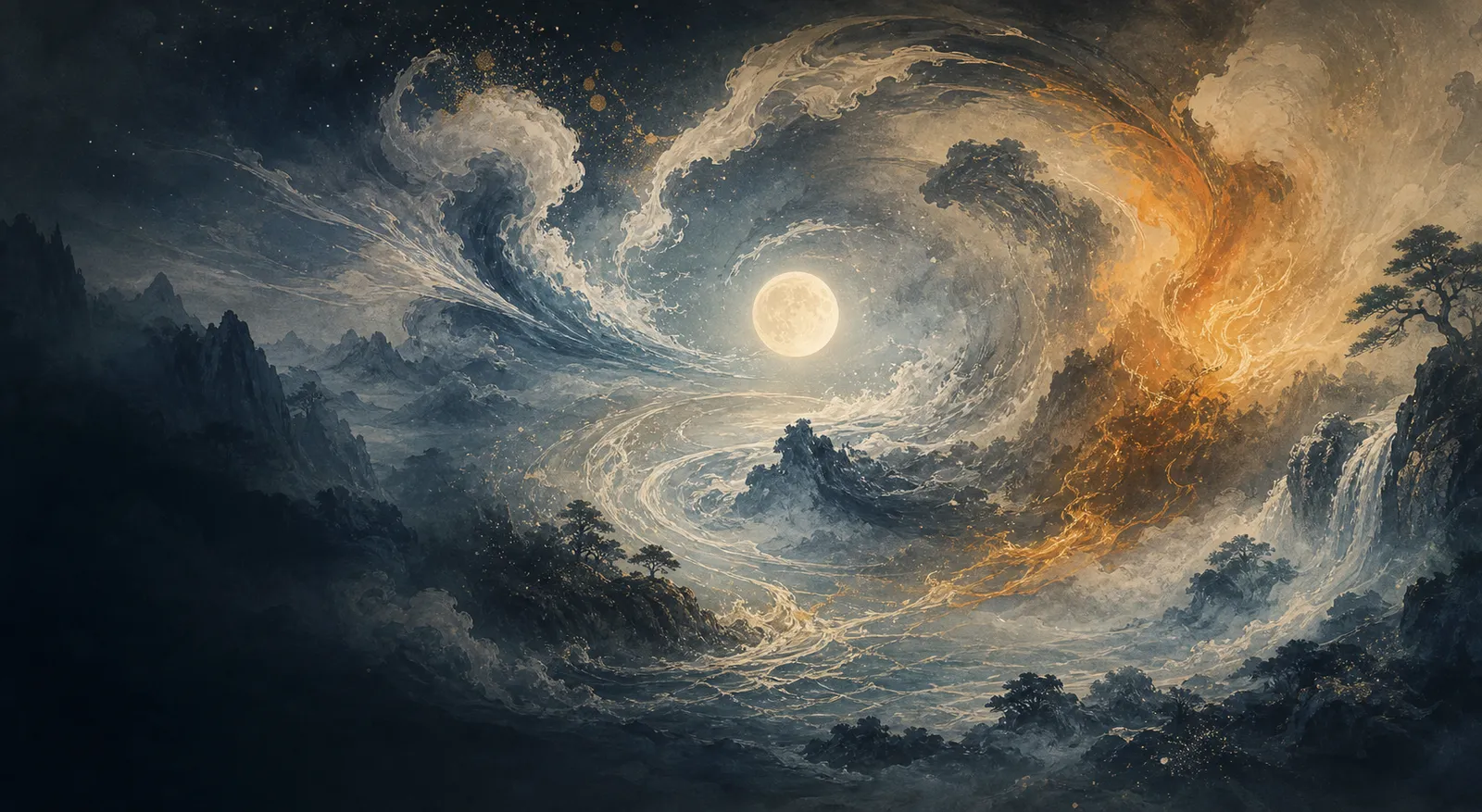
The Cosmic Dance: Core Cosmological Concepts in the I Ching
At its heart, the I Ching is a cosmological system, a map of the universe and its endless processes of change and transformation. Its symbols and texts are built upon a foundation of core concepts that have profoundly shaped Chinese thought for millennia. Understanding these concepts is key to unlocking the I Ching’s deeper philosophical meaning.
This article will explore the fundamental cosmological ideas inherent in the I Ching, including the dynamic interplay of Yin and Yang, the theory of the Five Elements or Phases (Wu Xing) and its connection to the I Ching’s framework, and the central role of Change (Yi) itself as the underlying principle of all existence.
The Breath of the World
Take a single breath. As you inhale, your lungs expand, your chest rises, and energy enters your system — this is the “Initiating” force. As you exhale, your body relaxes, your lungs empty, and you release — this is the “Receiving” force. This simple, rhythmic oscillation is the entire universe in miniature.
We often talk about the I Ching as a book of riddles, but it is actually a record of this breathing. In cosmology, we call this the Taiji (The Supreme Ultimate) expressing itself through Yin and Yang. It is the “Cosmic Dance” where nothing is ever truly still, and nothing is ever truly lost; it is simply in a different phase of the breath.
Reorienting Change: The Law, Not the Event
You may think that “Change” in the I Ching refers to the random, chaotic events that happen to us — the sudden job loss, the unexpected meeting, the storm. But in this system, Change (Yi) is not what happens; it is the constant law that governs everything.
Early commentators defined the title Yi (Change) with three simultaneous meanings:
- Bian-Yi (Ceaseless Change): Everything is in a state of flux.
- Bu-Yi (The Unchanging): The principles governing that flux — like the laws of physics or the cycle of seasons — never change.
- Jian-Yi (Simplicity): Despite the complexity of the world, it can all be reduced to simple, binary relationships between expansion and contraction.
| Cosmological Layer | Function | Why It Matters |
|---|---|---|
| The Taiji | The Source / The One | The unified field of potential before any division occurs. It represents your “North Star” or original intent. |
| Yin & Yang | The Binary Pulse | The expansion (Yang) and contraction (Yin) that create all form. The 0 and 1 of the cosmic computer. |
| Wu Xing (5 Phases) | The Quality of Time | How energy matures: Wood (Start), Fire (Peak), Earth (Balance), Metal (Harvest), Water (Seed). |
| Sancai (3 Treasures) | The Levels of Reality | The interaction between Heaven (Timing), Earth (Resources), and the Human (Agency). |
The Five Phases: More Than “Elements”
A common mistake is thinking of the Wu Xing — Wood, Fire, Earth, Metal, Water — as literal materials. In I Ching cosmology, they are Phases or Movements of energy. They describe how a situation ripens and eventually turns into its opposite.
- Wood is the energy of “upward and outward” growth (Spring). Think of a seed breaking soil.
- Fire is the energy of “upward and expanding” light (Summer). Think of a project at its most visible peak.
- Earth is the energy of “centering and balancing” transition (Late Summer). The pivot between growth and harvest.
- Metal is the energy of “inward and contracting” density (Autumn). Think of a harvest or the cutting of a contract.
- Water is the energy of “downward and still” potential (Winter). Think of the deep sleep before a new idea.
In the I Ching, these phases determine the “strength” of a reading. If you cast a “Fire” hexagram in the middle of a “Water” month (Winter), the cosmology tells us your energy is “Resting” or “Trapped.” It is like trying to start a campfire in a blizzard — the intent is fine, but the environment is working against you.
The Human Narrative Cycle
We see this cosmology in the “Three Treasures” (Sancai) structure of a hexagram. Every hexagram is a “State of the Union” for your life, divided into three domains:
- The top two lines represent Heaven: the timing, the macro-trends, and the “weather” of the situation you cannot control.
- The bottom two lines represent Earth: the resources, the physical location, and the hard facts on the ground.
- The middle two lines represent the Human: our choices, our heart, and our agency.
Most people experience crisis because they try to act (Human) without checking the timing (Heaven) or the resources (Earth). The I Ching’s job is to align the middle with the top and bottom.
Practical Application: Checking the Temperature
When looking at a hexagram from a cosmological perspective, ask yourself:
- Is this an inhale or an exhale? If your life is currently all Yin (broken lines), you aren’t “failing” — you are inhaling, gathering resources for the next Yang expansion.
- What is the phase of this project? Use the Wu Xing to identify if you are in “Wood” (starting) or “Metal” (ending). Don’t try to force a “Wood” beginning if the season is “Metal.”
- Am I out of step with Heaven or Earth? If the top lines are strong but the bottom lines are weak, you have a great vision but no money or support. Use the reading to see which “Treasure” needs your attention.
Closing Synthesis
The I Ching is a mirror of the cosmos, but it is not a distant one. It tells us that the same laws that govern the stars and the seasons govern our bank accounts and our heartbreaks. By understanding the “Cosmic Dance,” we stop treating life as a series of accidents and start treating it as a series of movements. We learn to breathe with the world, rather than against it.