Influence
A Thread Through Culture: The I Ching's Impact on Chinese Civilization
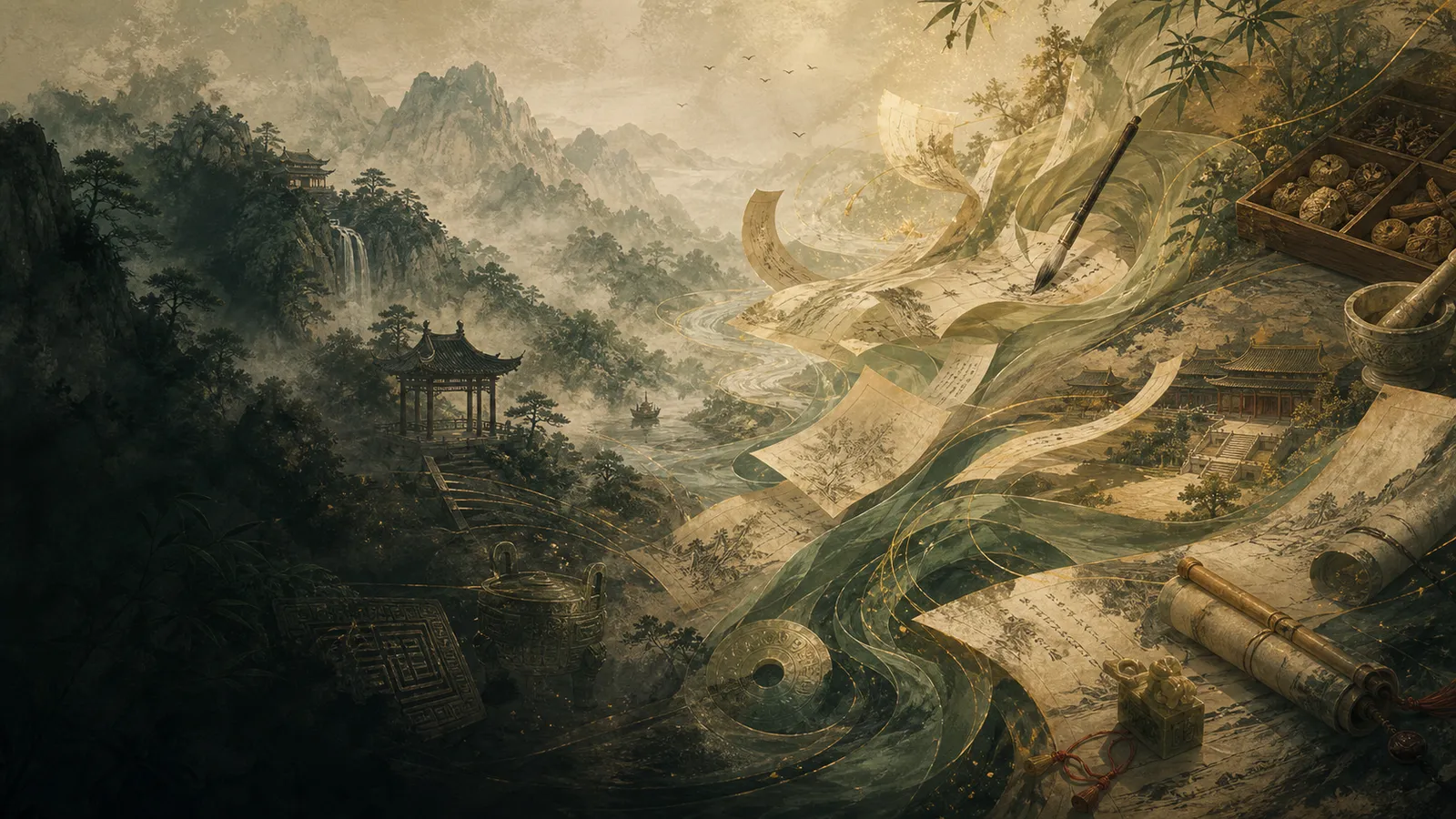
Beyond its core identity as a book of wisdom and an oracle, the I Ching (Yijing) has woven itself deeply into the fabric of Chinese civilization for over two millennia. Its concepts, symbols, and philosophical outlook have profoundly shaped not only China’s major schools of thought like Confucianism and Taoism but also its art, literature, calligraphy, traditional medicine, statecraft, scientific inquiry, and even everyday customs.
This article will explore the multifaceted impact of the I Ching on Chinese culture, examining how its principles have manifested in diverse fields and contributed to the unique character and development of one of the world’s oldest continuous civilizations.
The Warp of the World
Imagine a massive, ancient tapestry that stretches across three thousand years of history. The colors on the surface change — sometimes the vibrant reds of a thriving dynasty, sometimes the somber greys of conflict. But if you look at the back of the tapestry, you see the vertical threads holding the entire structure together. No matter what the picture on the front looks like, these warp threads never change.
The I Ching is the warp of Chinese culture. It is the silent, underlying logic that allows a doctor, a general, an architect, and an artist to all see the world through the same lens — the cultural DNA that makes the civilization recognizable across time.
Reorienting the Impact: A Language, Not Just a Book
You may think the I Ching is a book you pick up to read. In Chinese culture, it functions more like a master operating system or a shared vocabulary.
A doctor in ancient — or modern — China doesn’t just treat a disease; they balance the Yin and Yang of the organs. An architect doesn’t just build a house; they arrange the rooms to capture Qi (energy) based on the Ba Gua (Eight Trigrams). The system provides a unified framework for understanding how disparate parts of life interact.
| Cultural Domain | I Ching’s Functional Role | Lived Experience |
|---|---|---|
| Traditional Medicine (TCM) | The Internal Oracle | Mapping organ energy to the Five Phases and Yin/Yang lines |
| Feng Shui / Geomancy | The Environmental Map | Using trigrams to align human “Earth” with celestial “Heaven” |
| Art & Calligraphy | The Visual Oracle | Balancing the “Emptiness” (Yin) with the “Stroke” (Yang) |
| Martial Arts (Taiji/Bagua) | The Embodied Oracle | Moving the body in circular, flowing patterns of the trigrams |
| Governance / Strategy | The Political Oracle | Using the Mandate of Heaven to judge the timing of action |
The Body as a Living Hexagram
The impact of the I Ching is perhaps most alive in Traditional Chinese Medicine. The human body is viewed as a living hexagram, and health is defined as correctness (Dang-Wei) — when the energy lines are in their proper places.
Sickness is seen as an inversion. When the Fire of the heart rises too high and the Water of the kidneys sinks too low, the doctor’s work is to re-order the lines — using acupuncture or herbs to move the Qi so that Fire descends and Water rises, creating the hexagram of Harmony (Hexagram 11, Tai).
The Everyday Symbols
You recognize the I Ching’s impact in the most ordinary parts of Chinese life:
- The architecture of space: In Feng Shui, the Ba Gua is a literal map. If the wealth corner of a home falls in the Fire area but is occupied by a bathroom (Water), the symbolic logic tells the occupant that their wealth is being extinguished. This is the symbolic logic of system harmony.
- The philosophy of food: The balance of “Hot” (Yang) and “Cold” (Yin) foods in a meal follows the same principle of symmetry as the hexagram lines.
- The flag: Even modern political symbols — like the flag of South Korea — explicitly feature the Yin-Yang symbol surrounded by four I Ching trigrams.
Practical Application: Viewing Life as a System
To appreciate this cultural impact in your own practice, try looking through the warp lens:
- Think in complements: Don’t see a “problem” and a “solution.” See a Yin state that is naturally seeking its Yang partner.
- Check your environment: Look at your workspace. Is there too much Thunder (noise and chaos) where there should be Mountain (stillness and focus)? Re-arrange your trigrams.
- Align with the mandate: In business or leadership, ask whether your project has the Mandate of Heaven — meaning, is the timing (Heaven) supported by the resources (Earth) and your integrity (Human)?
Closing Synthesis
The I Ching is not just a Book of Changes — it is the Book of Continuity. It is the thread that connects the ancient shaman to the modern surgeon. By understanding its impact on Chinese culture, we realize the Oracle is not a choice we make; it is a fabric we are already part of. It reminds us that every act — from a bow to a business deal — is a move in a three-thousand-year dance of balance.