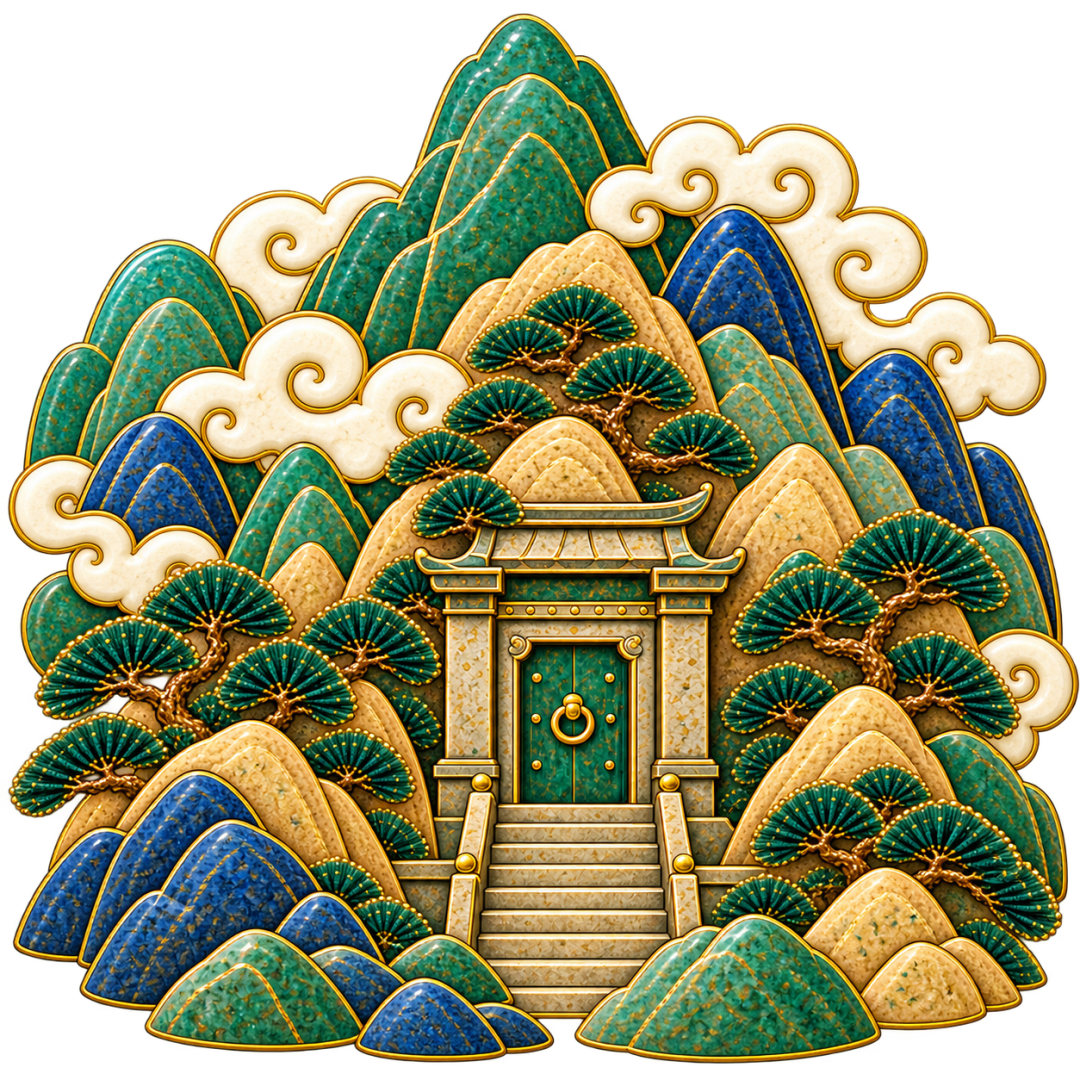
艮宫 · Keeping Still Mountain
The Wisdom of Stopping
There is a moment in every worthwhile endeavor when the wisest thing you can do is stop. Not pause. Not rest. Stop. The project that needs to be abandoned before it consumes more. The relationship that needs a boundary before it destroys both people. The habit that needs to end before it becomes identity. The thought that needs to halt before it becomes obsession.
The Gen Palace is the home of that stopping. The character 艮 (Gèn) depicts an eye looking backward — or a person turning to look behind. In the Shuo Gua, Gen is called 止 (zhǐ) — “the keeping still,” the force that stops, that sets boundaries, that knows when not to act. The trigram ☶ shows a broken yin line above two solid yang lines — the mountain that rises from the earth, immovable and self-contained.
If you’ve ever held a boundary until it hurt, ever said no when every voice screamed yes, ever stopped moving when movement seemed like the only option — you know Gen. This palace doesn’t move. It doesn’t need to. The mountain doesn’t chase the river; the river goes around the mountain. And the mountain remains.
卦德 · Gua De
What Gen Actually Means
The Xiang Zhuan for Gen states: “Mountains standing close together: the image of Keeping Still. Thus the superior man does not permit his thoughts to go beyond his situation.” This captures Gen’s essence: the wisdom of staying within proper bounds. The Da Xue (大學, Great Learning) famously says: “The point where to rest being known, the object of pursuit is then determined.” This “point where to rest” is the Gen principle — knowing where to stop is the foundation of all achievement.
As the Youngest Son, Gen represents the final stage of yang development — the boundary that yang energy meets as it completes its cycle. Where Qian creates, Zhen initiates, and Kan navigates danger, Gen knows when to stop. The youngest son has watched all his older siblings and learned that sometimes the most powerful action is refusal. The most courageous move is non-movement.
The dog is Gen’s animal — loyal, guarding, knowing when to stop and when to defend. The Shuo Gua says: “Gen is the dog. Gen stops, mastering defense.” The dog’s relationship to fire reveals a deeper connection: Gen is the essence of fire — fire that has been contained, transformed from consumption to warmth. The mountain doesn’t burn; it holds the fire within.
化境 · Transformation
Why Stillness Must Learn to Move
The Gen Palace contains a paradox: the mountain that never moves is the foundation of all movement around it, but the mountain that absolutely never moves becomes a barrier rather than a foundation. The Tuan Zhuan says: “When it is time to stop, stop; when it is time to act, act. Movement and stillness do not miss their proper time — the Way is bright and clear.”
This is Gen’s deepest teaching: stopping is not the opposite of movement but its complement. The mountain does not move, yet it is the foundation of all movement around it. Knowing when to stop is as important as knowing when to act. And knowing when to start moving again — even slowly, even gradually — is as important as knowing when to be still.
The resolution in Jian (Gradual Progress) is profound: the mountain that has learned to allow wind above it, to let trees grow on its slopes, to permit gradual change — this mountain is stronger than the one that refuses all change. Rigid stillness breaks; flexible stillness endures.
占断指引 · Reading Guidance
Reading Gen Palace Hexagrams
When a Gen Palace hexagram appears, you’re being shown where boundaries and stillness are in their lifecycle. This isn’t about whether you have boundaries; it’s about what your boundaries are doing to you and others.
Are your boundaries protecting or imprisoning?
Gen (52) is healthy stillness; Kui (38) is the isolation that excessive boundaries create.
What are you accumulating, and what is it costing?
Da Xu (26) builds through restraint; Sun (41) shows the cost of excessive holding.
Is your inner truth aligned with your outer rigidity?
Zhong Fu (61) as Wandering Soul reveals the split between external rules and internal authenticity.
Can you move gradually?
Jian (53) teaches that the final form of Gen is not sudden achievement but steady, organic growth.
医易同源 · Medicine
The Medicine of Gen
In Traditional Chinese Medicine, Gen shares the Earth element with Kun but represents the containing and stopping power of the mountain. Where Kun receives and transforms, Gen holds and boundaries. The back and joints are Gen’s body territories — the structures that hold us upright and define our range of motion.
| Condition Type | Gen Indicators | Treatment Principle |
|---|---|---|
| Excessive Rigidity | Stubbornness, inability to adapt, back pain | Gentle movement, flexibility practice |
| Boundary Deficiency | Restlessness, poor boundaries, incomplete projects | Establish one clear stopping point daily |
| Isolation | Social estrangement, rigid thinking | Gradual reconnection, one person at a time |
| Inner/Outer Split | Rules followed without belief | Return to inner sincerity, examine true values |
山德 · The Gift
The Gift of Gen
The Gen Palace gives gifts that only the journey through stillness can confer:
- Discriminating stopping — Knowing exactly where to draw the line
- Contained power — The strength that doesn’t need to announce itself
- Graceful boundaries — The ability to say no without wounding
- Patient endurance — The capacity to hold position without rigidity
- Gradual wisdom — Understanding that the mountain moves, just very slowly
心法 · The Master's Secret
What Masters Know About Gen
Masters know that Gen’s stillness is not the absence of movement but the mastery of it. The mountain doesn’t move because it doesn’t need to. Everything that needs to move moves around it. The river flows. The wind blows. The seasons change. The mountain watches.
The key is knowing that the mountain does change — just on a timescale that human impatience cannot perceive. Mountains rise and fall over millions of years. The Gen master has learned to be patient with their own transformation, to allow gradual progress rather than demanding sudden breakthrough, to trust that holding still is sometimes the most powerful move available.
修卦 · Practice
Your Gen Palace Practice
The Week of the Mountain:
For one week, practice conscious stopping:
- Choose one area where you normally act — and stop
- When you feel the impulse to respond, pause and ask: does this need my action?
- Practice one graceful “no” each day — kind but firm
- Notice what happens in the space you create by not filling it
Notice how this changes your sense of power. Notice that the mountain doesn’t become less powerful by not moving — it becomes the reference point for everything that does move. That unmoving presence — the stillness that outlasts every storm — is Gen’s deepest gift.
The Mountain That Knows When to Move
The Gen Palace teaches us that stillness is not the opposite of power but one of its most refined expressions. The mountain doesn’t resist the river; it simply doesn’t move. The boundary doesn’t attack; it simply doesn’t yield. The person who knows when to stop doesn’t need to fight — their stopping is the fight, already won.
When you understand Gen, you stop seeing non-action as passivity. You recognize that the decision not to act is often more difficult than the decision to act. The “no” that costs you a relationship but preserves your integrity. The pause that prevents a mistake. The boundary that creates the space for something better to grow.
Remember: everyone needs Gen. Everyone needs to stop sometimes, to set boundaries, to say no, to refuse. The question isn’t whether you’ll need stillness but whether you’ll choose it consciously — knowing when to be immovable and when to allow gradual movement, when to hold the line and when to let the wind shape your slopes. The youngest son who has learned this — who maintains boundaries without becoming rigid, who stops without becoming stuck — has learned one of the deepest lessons the I Ching offers.