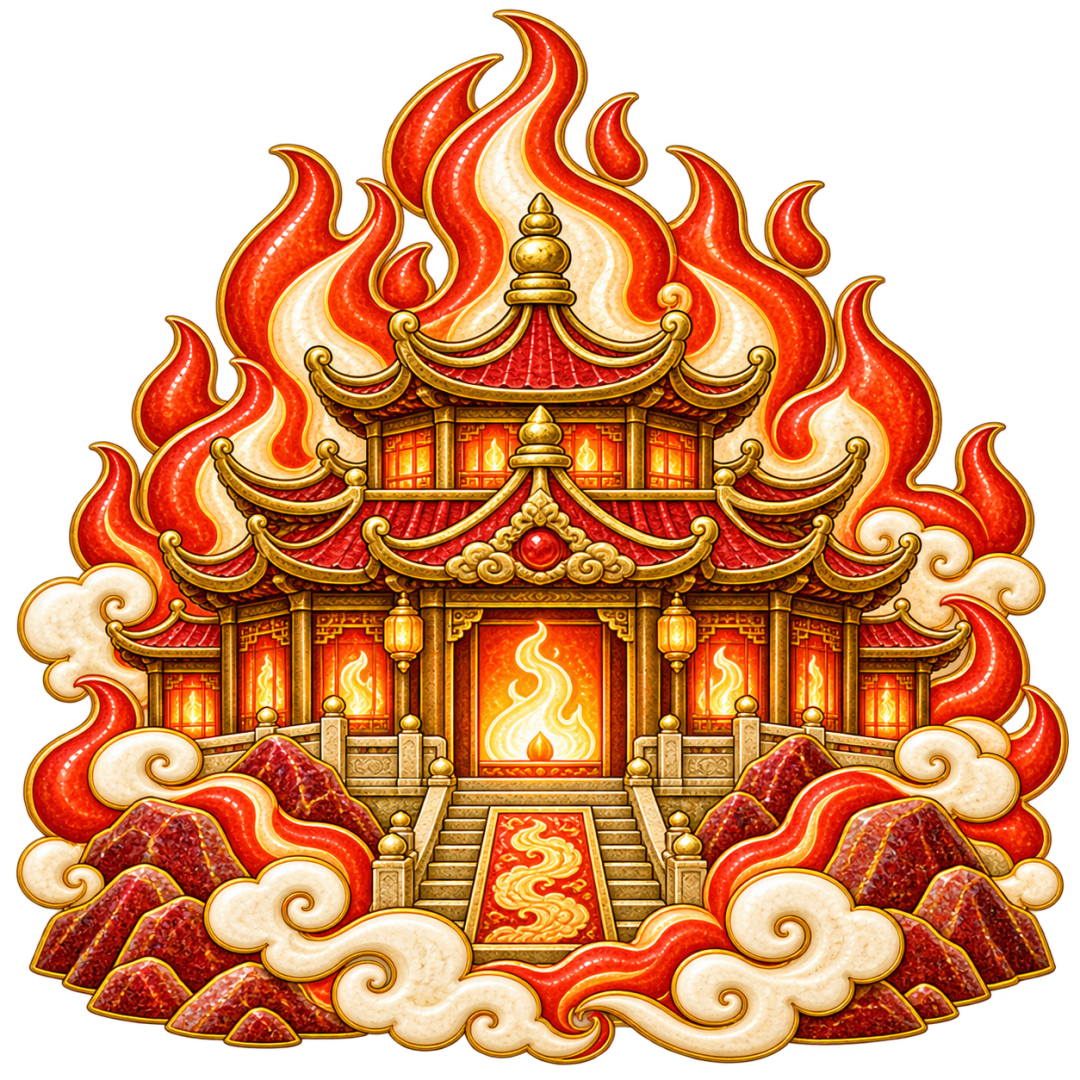
离宫 · The Clinging Fire
The Paradox of Complete Dependence
Here’s something that might surprise you about fire: it’s the only element that has no substance of its own. You can hold earth, contain water, feel wind, even work with metal. But fire? Fire exists only as an event, a process, a relationship. The moment it stops consuming, it ceases to exist.
This complete dependency would seem to make fire the weakest element. Yet paradoxically, it’s fire that provides light to see, warmth to survive, and the power to transform everything it touches. The Li Palace embodies this profound paradox — absolute dependency creating transformative power.
The character 离 (Lí) contains a beautiful paradox: it simultaneously means “to separate” and “to attach.” How can one word mean two opposite things? This captures fire’s essential nature perfectly. To see something clearly, you must separate yourself enough to observe it. Yet to truly understand it, you must connect with it intimately. The flame that illuminates the wood is separate from it yet completely attached to it. If you’ve ever felt the double-edged sword of visibility — being seen and recognized but also exposed and vulnerable — then you know Li intimately.
卦德 · Gua De
What Fire Really Means in This System
Let’s clarify what “Fire” means in the Ba Gong system. This isn’t the fire in your fireplace. This is fire as consciousness itself — the light of awareness that illuminates existence, the passion that drives connection, the transformative force that changes everything it touches by the very act of touching it.
The Xiang Zhuan states: “The brightness rises into the sky: the image of the Clinging. Thus the great man, by his continuous generation of light, illuminates the four quarters of the world.” But the Tuan Zhuan adds the warning: “The clinging is dependent.” Fire exists only as relationship — it has no substance of its own.
In Taoist internal alchemy, Li (☲) is outer yang, inner yin — the Fire trigram contains hidden water, true yin within brightness. The alchemical work is to extract this hidden essence and unite it with Kan‘s hidden yang. This “Kan-Li copulation” produces the elixir — the restoration of primordial unity. Li teaches that even in our brightest moments, something dark and receptive waits to be integrated.
化境 · Transformation
Why Fire Creates Both Clarity and Blindness
The Li Palace teaches a counterintuitive truth: the brighter your consciousness, the darker the shadows you create. Every illumination creates a new darkness. Every understanding changes what’s understood. Every attachment that allows you to see also makes you vulnerable to loss.
This is why so many brilliant people struggle with depression — the shadow of their brightness. Burnout — consuming their fuel too quickly. Isolation — seeing what others can’t. The Li journey isn’t about maintaining constant brightness but learning to work with fire’s natural cycles of illumination and exhaustion, attachment and separation.
The Da Xiang Zhuan says: “Double brightness arises.” Not a single flash of insight but the continuous generation of light — the sun rising day after day, the fire burning night after night. True illumination is not a moment but a practice. And like all practices, it includes periods of rest.
占断指引 · Reading Guidance
Reading Li Palace Hexagrams
When a Li Palace hexagram appears, you’re being shown where consciousness is actively transforming through attachment and illumination. This isn’t about stable understanding but active transformation through the very act of seeing.
What is your consciousness attached to?
What’s fueling your fire?
Is the fuel sustainable?
Are you burning through resources too quickly?
What shadows is your brightness creating?
What can’t you see because of what you can see?
How can you share your light?
Fire sustained collectively lasts longer than isolated flames.
医易同源 · Medicine
The Medicine of Fire
In Traditional Chinese Medicine, Li governs the Heart — not just the organ but the entire system of consciousness, blood circulation, and shen (spirit). The Heart houses the shen and governs mental activity. The Small Intestine separates pure from impure — both physically and metaphorically.
| Condition Type | Li Indicators | Treatment Principle |
|---|---|---|
| Heart Conditions | Fire imbalance, palpitations | Cool and calm the fire |
| Inflammation | Excessive heat | Resolve and cool |
| Burnout | Fuel exhaustion | Nourish wood (fuel) |
| Anxiety | Scattered fire | Ground and center |
| Vision Problems | Light disturbance | Clarify and focus |
火德 · The Gift
The Gift of Li
The Li Palace gives unique gifts:
- Clarity of vision — Seeing what others miss
- Transformative power — Changing what you touch
- Creative fire — Bringing new things into being
- Conscious awareness — Knowing that you know
- Connection capacity — Understanding through attachment
But these gifts come with costs: vulnerability through dependency, exhaustion from consumption, isolation from brightness, shadows from illumination, burnout from intensity. The Li master has learned to accept both.
心法 · The Master's Secret
What Masters Know About Li
Masters know that fire’s complete dependency isn’t weakness — it’s the source of its power. By accepting that you need others, need fuel, need connection, you gain the ability to transform everything you touch.
The key is choosing your fuel wisely. What you attach to determines what kind of fire you become. Attach to fear, become anxiety. Attach to love, become warmth. Attach to truth, become illumination. The pheasant’s patterned plumage is beautiful, but it responds to wind direction — it can only maintain its position when conditions are right. Choose your conditions consciously.
修卦 · Practice
Your Li Palace Practice
The Week of Fire:
For one week, practice conscious attachment:
- Notice what fuels your energy each day
- Track what you’re consuming — physically, mentally, emotionally
- Observe how your brightness affects others
- Feel the difference between sustainable and consuming fire
Notice how this changes your relationship with dependency and connection. Notice what remains when you stop trying to be independently bright. That interdependence — the fire that knows it needs the wood — is Li’s deepest wisdom.
The Dependent Light
The Li Palace stands as the bright counterpart to Kan‘s darkness, yet both share a fundamental truth — transformation happens through relationship, not in isolation. Where Kan teaches that wisdom comes through danger, Li teaches that clarity comes through attachment.
Fire’s complete dependency on fuel becomes a perfect metaphor for consciousness itself — we can only be aware of something, can only illuminate by attaching, can only transform through connection. This isn’t a limitation but the very mechanism of awareness.
When you understand Li, you stop trying to be independently bright and start asking what sustainable fuel can support your light. You stop fearing dependency and start choosing your attachments consciously. You stop burning out alone and start building fires that can be tended collectively.
Remember: everyone needs the Li Palace because everyone needs to be seen, to see clearly, to transform and be transformed. The question isn’t whether you’ll experience Li’s journey but how consciously you’ll choose what fuels your fire.