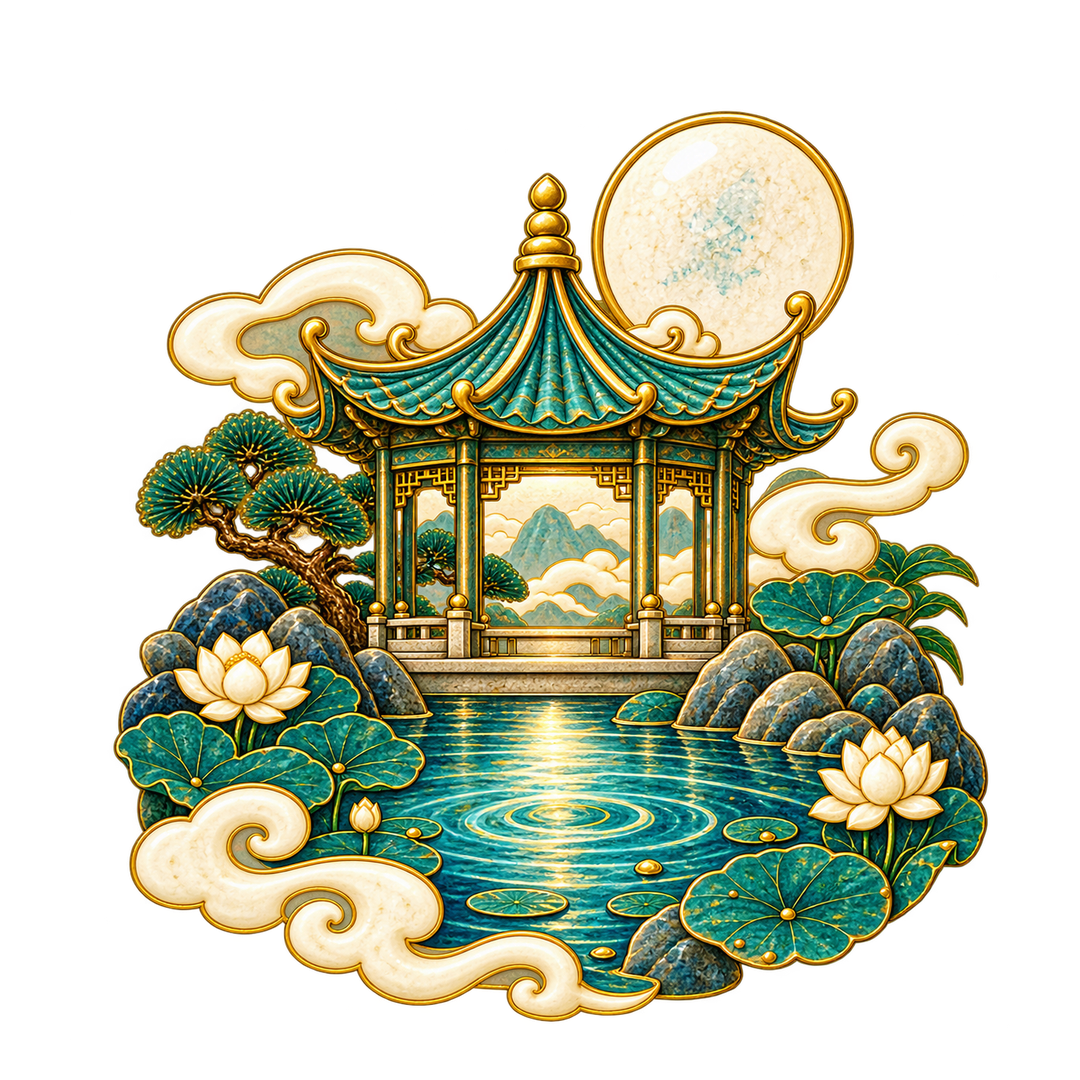
兑宫 · The Joyous Lake
The Testing of Joy
There’s a particular kind of exhaustion that comes from joy — the hollow feeling after the celebration ends, the social fatigue that follows too much delight, the realization that what felt like pure pleasure was actually a surface shimmer on deeper waters. The Dui Palace knows this territory intimately. Where Qian tracks the erosion of authority, Dui tracks the transformation of joy — from surface pleasure through testing, gathering, attraction, obstacle, and finally into the mature joy that includes life’s difficulties rather than denying them.
The character 兑 (Duì) depicts a person with an open mouth — speaking, laughing, singing. The trigram ☱ shows a broken yin line at the top above two solid yang lines: the marsh or lake that reflects the sky, mirroring beauty back to the world. But a reflection is not the sky itself, and a lake that reflects without depth will eventually drain.
If you’ve ever experienced joy so complete it exhausted itself, pleasure so intense it left emptiness, or delight that demanded increasingly extreme conditions to reproduce, you’ve walked the Dui Palace path. This isn’t a failing — it’s the natural lifecycle of joy, and understanding its sequence transforms how you relate to pleasure itself.
卦德 · Gua De
What Dui Actually Means
In the Shuo Gua, Dui is called 悦 (yuè) — “the joyous.” But this is not mere happiness. The Xiang Zhuan states: “Lakes resting on one another: the image of the Joyous. Thus the superior man joins with his friends for discussion and practice.” Dui’s joy is inherently social, communicative, and shared. It is the pleasure of exchange, the delight of recognition, the celebration that marks fulfillment.
The Tuan Zhuan adds a crucial layer: “Firm in the middle and gentle without — this is the joyous.” The two yang lines at the bottom provide inner firmness, while the single yin line at the top creates outer gentleness. True joy is not weakness — it is strength expressed through pleasure, firmness that has learned to smile. The sheep embodies this: gentle on the surface, firm beneath.
Dui’s central teaching: joyous communication fulfills its potential only when bound by enduring mutual responsibility. The lake that reflects the sky is most beautiful when held by the earth that contains it.
化境 · Transformation
Why Joy Must Become Commitment
The Dui Palace makes a counterintuitive claim: the highest form of joy is not endless pleasure but conscious commitment. The Xiang Zhuan says the superior man “joins with his friends for discussion and practice” — joy is inherently relational, not solitary. And relationships require boundaries, obligations, mutual responsibility.
Pure joy is like a lake without banks — it spreads everywhere and nourishes nothing. The banks that seem to restrict the lake are actually what allow it to become deep. The conditions that seem to limit joy are actually what allow it to become real.
This is why the Dui sequence ends with Gui Mei, the Marrying Maiden — not with perpetual celebration but with formal covenant. The joy that has been tested by hardship, deepened through community, focused through attraction, strengthened through obstacle, matured through humility, and purified through crisis — that joy is ready for commitment. Everything before was preparation.
占断指引 · Reading Guidance
Reading Dui Palace Hexagrams
When a Dui Palace hexagram appears, you’re being shown where joy — or its absence — is in its lifecycle. This isn’t about whether you’re happy; it’s about what form your happiness is taking and what it needs to become.
Is this joy being tested, or is it avoiding testing?
Kun (47) immediately follows Dui (58) — the first lesson is that joy must withstand hardship.
Where does your joy come from?
Surface pleasure, shared community, specific connection, or mature commitment?
Are you in the fragmentation stage?
Xiao Guo (62) represents joy scattered into tiny pleasures — jumping from one to the next, never satisfied.
What commitment wants to emerge?
The Returning Soul asks not what makes you happy but what you’re willing to bind yourself to.
医易同源 · Medicine
The Medicine of Dui
In Traditional Chinese Medicine, Dui shares the Metal element with Qian but governs the Mouth, Throat, and Lungs from a different angle. Where Qian represents the Lung’s authority (breath, boundary-setting), Dui represents the Mouth’s joy (communication, taste, pleasure, expression).
When Dui energy is excessive, there is gossip, superficiality, pleasure-seeking, and the inability to stop talking. When deficient, there is inability to express joy, social withdrawal, and communication breakdown. The treatment principle is always the same: restore the firm yang lines at the base (inner strength) while allowing the gentle yin line at the top (social expression) to function naturally.
| Condition Type | Dui Indicators | Treatment Principle |
|---|---|---|
| Excessive Joy | Manic socializing, inability to stop talking | Ground in silence, restore inner firmness |
| Joy Deficiency | Social withdrawal, inability to express pleasure | Small shared activities, gentle community |
| Fragmentation | Addictive pleasure-seeking, never satisfied | Commitment to one thing, depth over breadth |
| Superficiality | Glossy relationships without substance | Allow difficulty to deepen the bond |
泽德 · The Gift
The Gift of Dui
The Dui Palace gives gifts that only the journey through joy’s full lifecycle can confer:
- Resilient joy — The capacity to find satisfaction even when circumstances are difficult
- Relational depth — Understanding that joy is not a private sensation but a shared phenomenon
- Discerning pleasure — Knowing the difference between sensation that entertains and connection that nourishes
- Commitment capacity — The ability to bind yourself to something and find joy within the binding
- Completion wisdom — The knowledge of when to celebrate, when to rest, and when to begin again
心法 · The Master's Secret
What Masters Know About Dui
Masters know that Dui’s joy is not the opposite of difficulty but includes it. The Shuo Gua says Dui is “the means by which all things are brought to completion” — joy marks the end of a cycle, the celebration of work done. But completion is also a beginning. The lake that has given all its water must wait for rain.
The secret is choosing your banks wisely. What you commit to, what you allow to contain your joy, determines what kind of lake you become. Commit to shallow things, become a shallow lake. Commit to deep things, become a deep lake. The banks don’t restrict you — they make depth possible.
修卦 · Practice
Your Dui Palace Practice
The Week of the Lake:
For one week, practice reflective joy:
- Each evening, name one thing that genuinely satisfied you — not entertained you, but satisfied you
- Notice which satisfactions came from others and which you generated alone
- Observe where you seek pleasure out of habit rather than genuine desire
- Practice one small commitment — something you do every day regardless of mood
Notice how the quality of your joy changes when you introduce banks — when you choose containment rather than endless expansion. The lake with borders becomes deeper than the water without them.
The Covenant of Joy
The Dui Palace teaches us that joy is not a destination but a journey — one that must pass through testing, community, attraction, obstacle, and humility before it can arrive at commitment. The person who expects perpetual celebration without transformation hasn’t understood Dui. The person who flees joy at the first sign of difficulty hasn’t understood Dui either.
When you understand the Dui Palace, you stop chasing peak experiences and start building sustainable satisfaction. You recognize that the exhaustion after celebration is not failure but the invitation to deeper joy. You learn that the obstacle in your relationship isn’t a sign to quit but the friction that will either break the bond or forge it into something stronger.
Remember: everyone experiences pure joy and its erosion. Everyone knows the hollowness of pleasure without depth. The question isn’t whether you’ll walk the Dui Palace path but whether you’ll walk it consciously — transforming surface delight into covenantal commitment, scattered pleasure into focused satisfaction, the fleeting lake into the deep reservoir that sustains through every season.